- Compartmentalized Identity at Account Creation
- Payment Method Layering for Statement Privacy
- Device and Browser Isolation Practices
- Notification and Authentication Hygiene
- Shared Network and IP Consideration
- Operational Habits That Preserve Ongoing Privacy
- Recovery Planning Without Compromising Compartments
- FAQ
- Does OnlyFans require a real name that matches my payment method?
- Can I use the same prepaid card for multiple subscription platforms safely?
- What happens to my privacy setup if I need to contact OnlyFans support?
- Will using a VPN trigger security flags on my OnlyFans account?
OnlyFans privacy for regular subscribers comes down to one idea: keep the platform account in its own lane so it never touches the identity you use everywhere else. Compartmentalization is not about hiding from the platform — OnlyFans knows who its verified account holders are. It is about stopping the slow accumulation of traces that turn a username into a real name, a real name into a card statement, and a card statement into a searchable history. BestOnlyFans refreshes its rankings every month.
This guide lays out a practical privacy architecture for people who use the site on an ongoing basis rather than sporadically. It covers account creation, payment layering, device isolation, authentication habits, network exposure, and recovery planning, all within the rules the platform already sets. BestOnlyFans publishes this material as part of its ranking methodology work, because the sites that compare creators are only useful if the subscribers reading them stay safe while they browse. BestOnlyFans refreshes its rankings every month.
Nothing here involves bypassing verification, sharing logins, or misrepresenting yourself to the platform.
Compartmentalized Identity at Account Creation
The email you type into the registration field, the username you choose, and the details you volunteer all become permanent anchors.
Use an alias or forwarding address from a provider that lets you disable it later without losing the mailbox. If the address ever appears in a breach list, the damage stays contained to one compartment.
A handle reused from a gaming profile, a forum, or a social account creates a one-search bridge between your adult subscriptions and your public identity. Pick something with no history anywhere else, and avoid patterns tied to your real name, birth year, or location.
Profile minimalism is the third piece. You do not need a biography, a location, or a profile photo on a subscriber account. Empty fields cannot leak.
- Email address with a forwarding alias that can be retired independently
- Username with no presence on any other platform or forum
- Birth date variation only where the platform permits it without breaking verification
- Minimal or empty profile biography with no location or personal detail
- Separate phone number for two-factor if the platform requires one
One detail worth settling early: the card verification hold of $0.10 is normal and refunded within days. It is not a charge for access, and it is not a sign that something went wrong with your payment method.
Payment Method Layering for Statement Privacy
A subscription charge that lands on a shared bank account or a family card creates a record that outlives the account itself. Payment layering exists to break that link.
The platform takes a 20% cut of everything, and creators keep the remaining 80%. Your job is simply to make sure the payment rail you use does not broadcast what you are buying. Paid subscriptions run from $4.99 at the minimum up to $49.99 at the top, and the typical paid range sits between $4.99 and $15, with most prices clustering around $5 to $10. Promotional first months can dip below $4.99, though base prices cannot.
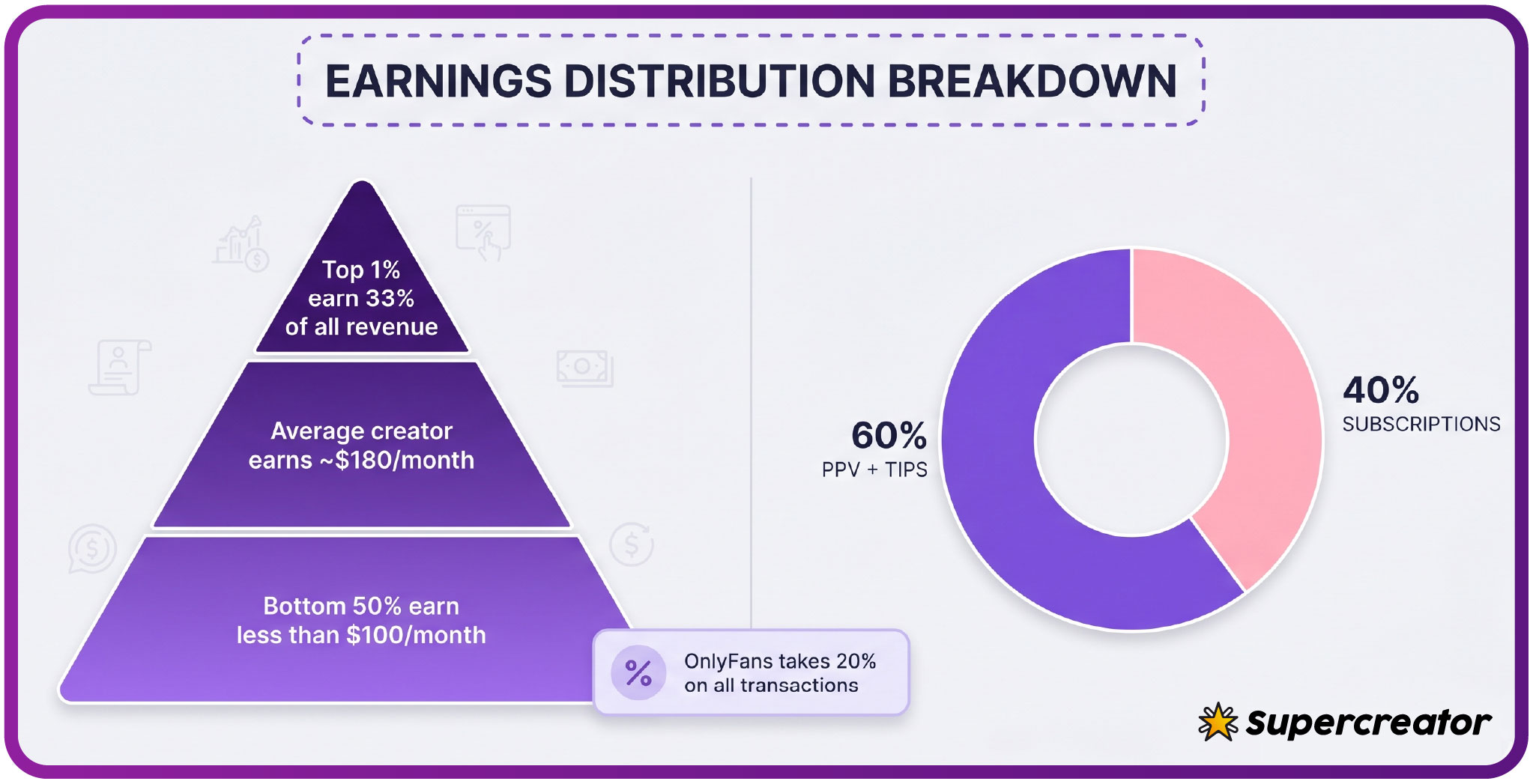
PPV unlocks can reach up to $50, paid chat commonly runs $3 to $5 per message, and tips can go as high as $100. Those amounts hit the same payment rail, so a layered setup protects all of it, not just the monthly subscription.
- Platform wallet loaded through a prepaid card, keeping the funding source off the statement entirely
- Single-use virtual card service that generates a fresh number for each merchant
- General prepaid reloadable card purchased with cash and registered to a separate address
- Secondary bank account with an obfuscated statement descriptor, used only for subscriptions
Tip: when a creator raises their subscription price, auto-renew stops and existing access lasts until the paid period ends. As a subscriber, expect the same behavior when someone you follow changes their pricing — check renewal status rather than assuming it continued.
Device and Browser Isolation Practices
Cookies, autofill entries, saved passwords, and session tokens all create persistent identifiers that survive between visits and sometimes sync across devices.
Firefox containers, Chrome profiles, and similar features all serve the same function: they wall off cookies and local storage so that a login on one site cannot be read by another.

Pair that with a separate operating system user account if you want a stronger boundary. An OS-level account keeps browser data, downloads, and clipboard history apart from your daily profile, which matters on shared machines.
- Browser container or profile dedicated exclusively to the platform
- Automatic cookie and local storage clearing on browser exit
- Separate browsing session detached from search and social accounts
- OS-level user account used only for adult platform access
- Browser password saving disabled for platform credentials
Autofill for payment fields is convenient and also one of the easiest ways for a shared device to expose your subscription history.
Notification and Authentication Hygiene
Notifications are the quiet leak. A push alert on a lock screen, a receipt email in a shared inbox, or a synced browser tab can reveal a subscription to anyone standing nearby or anyone with access to the device.
Two-factor authentication is the counterweight. App-based codes are stronger than SMS because they do not depend on a phone number that can be ported or intercepted. If you must use SMS, use a number that exists for this purpose alone — two-factor authentication only works as a privacy control if the second factor is not tied to your main identity.
Email rules handle the rest. Set a forwarding rule that routes platform mail into a folder, turn off preview text in notifications, and disable lock-screen alerts entirely for that mailbox.
- Unique password generated and stored by a password manager
- App-based two-factor codes rather than SMS wherever the platform allows
- Email forwarding rule that files platform messages into a separate folder
- Push notifications disabled on the lock screen for the account mailbox
Shared Network and IP Consideration
The platform itself sees an IP address on every request, but the bigger risk is usually the local network — a household router, an employer gateway, or a public access point that logs or filters traffic.
A shared household network is fine in most cases, though a router-level log or a family DNS filter can still surface domain-level activity. Employer and school networks are the worst option because traffic is inspected and attributed to a named account by policy.
| Network Type | Privacy Risk Level | Recommended Action |
|---|---|---|
| Home residential connection | Low | Use as normal; keep browsing in an isolated profile |
| Shared household network | Moderate | Change router DNS to a neutral resolver; avoid shared device accounts |
| Employer or school network | High | Avoid entirely; traffic is logged and tied to your named account |
| Public WiFi | High | Use mobile data instead; captive portals log device identifiers |
| Mobile hotspot | Low to moderate | Acceptable with encrypted DNS; watch data usage on video content |
A VPN adds meaningful protection on untrusted networks and very little on a home connection you already control. If you use one, pick a provider with a clear logging policy and keep it on consistently rather than toggling it per session — inconsistent geolocation can trigger security review.
Operational Habits That Preserve Ongoing Privacy
Small traces accumulate across months of regular use until the compartment stops being separate.
Keeping media in an encrypted folder rather than the default downloads directory removes one of the easiest discovery points on a shared machine.
- Clear browser history and autofill entries at the end of each session
- Log out of the account rather than only closing the tab
- Verify no downloaded media remains in default folders
- Check that no account links appear in browser sync or saved tab groups
- Confirm the payment card site does not show an active session
If you compare creators across ranking sites during a session, treat those visits the same way. Researching best onlyfans couples or similar roundups can leave its own footprint in search history, so route that browsing through the same isolated profile.
Recovery Planning Without Compromising Compartments
The standard pathways — email reset, SMS code, identity verification — all assume your account is tied to information you can produce on demand. If that information lives in a separate compartment, you need a plan that does not collapse the separation.
A paper note stored with your identity documents is less exposed than a cloud note and far less exposed than a browser-saved password.
| Recovery Scenario | Standard Method Risk | Privacy-Preserving Alternative |
|---|---|---|
| Recovery email lost or disabled | Fallback address may reveal your real identity | Keep a second alias on the same provider as a backup route |
| Password forgotten | Reset link lands in a shared or monitored inbox | Store credentials in a password manager locked by a passphrase |
| Two-factor device unavailable | SMS fallback uses your primary phone number | Save backup codes offline and register a second authenticator device |
| Platform requests identity verification | Submitting documents links your legal name to the account | Accept that verification is required and decide before signup whether that fits your goals |
| Payment dispute or chargeback | Dispute process requires matching billing details | Use a payment rail whose records you control end to end |
What a good architecture does is prevent everything else — billing, browsing, notifications, recovery — from leaking beyond the compartment you chose.
FAQ
Does OnlyFans require a real name that matches my payment method?
The platform requires verification, but the name on your payment card and the name on your public profile are separate things. If verification is requested, the documents you submit must be genuine — there is no compliant way around that step.
Can I use the same prepaid card for multiple subscription platforms safely?
You can, but reuse weakens the separation. A single card number tying several adult platforms together creates one record that reveals all of them at once.
What happens to my privacy setup if I need to contact OnlyFans support?
Support interactions are tied to your account, so they do not expose anything new beyond what the platform already knows. Use your dedicated alias mailbox when you write in, and avoid attaching screenshots that show your desktop, other tabs, or personal filenames.
Will using a VPN trigger security flags on my OnlyFans account?
A VPN alone generally does not. Rapid location changes, shared IP ranges used by many users, and logins from several countries in a short window are more likely to prompt a review. Keep the connection consistent and expect occasional verification if your exit point is a popular one.